GRC Blog


Welcome to the GRC Recorders pages. This blog provides details on all the relevant news of Glamorgan’s scarcer birds, plus all BBRC & WRP decisions that affect us locally. It will also be used to document the status and occurrence of these scarcer species and we welcome contributions from anyone with photographs, artwork or documentation of rarities past, present and future. The GRC also welcomes all seawatching news from around Glamorgan and news of passage migrants in spring & autumn, uncommon birds in our area and unusual behaviour.


All visitors are welcome. You must first register by sending an email to GlamRC@gmail.com before you can contribute. An invite will be sent to your email address. Blog content will be strictly moderated. Access to pages and downloads are available to everyone. All photographs on this blog remain the property of the originator.
If you would like to use photos, please arrange permission beforehand.


The Glamorgan Rarities Committee, in conjunction with the Glamorgan Bird Club & Gower Wildlife , have agreed to co-operate with the Welsh Ornithological Society in the sharing of bird records & photographs in the interest of keeping accurate records and to promote birdwatching in North, Mid & South Wales.

Friday, 10 May 2013

Pomarine Skuas again from PT Docks

Dark morph Arctic Skua
Seawatching 07:50 to 11:00 (MHi & later RJ)

5 (all pm) Pomarine Skuas and 3 (2 dm + 1 pm) Arctic Skuas were the highlights
Pale morph Pomarine Skuas
Following yesterday's rather nice gathering of skuas I was keen to see if any had stopped overnight or whether more might pass today. A slow start eventually got going at 08:30 with a dm Arctic Skua heading purposely towards Mumbles. Another half hour before 3+ Pomarine Skuas appeared from nowhere (presumed to be on the sea earlier) and did a relaxed circuit between the harbour and offshore from Kenfig river at 09:10. Following this at least 4 Pomarine Skuas were watched flying short distances and settling on the sea in this same general area. The wind dropped off markedly at about 09:40 and about 10 mins later 3 Poms headed out towards Mumbles with much more intent than their earlier flights had demonstrated. Later still at about 10:25, 2 Pomarine Skuas passed close by and were followed, almost immediately afterwards by 2 (dm+pm) Arctic Skuas passing even closer by. We were confident that there was no double counting at play here, indeed there may have been more than 5 Pomarine Skuas involved.

It makes sense that springtime passage should produce good skua days in South Wales, with the skuas heading back north in good numbers, and especially with winds blowing into our bays and channels. There is the added bonus also, that many of them own full streamers at this time, which make the id process a little easier.

NOTE Port Talbot Docks is access by permit only, however I don't doubt that regular seawatching haunts either side of this location would have experience at least the same rewards today, and probably better?

Aythya sp. (1), Great Crested Grebe (3), Fulmar (4), Gannet (2), Pomarine Skua (5), Arctic Skua (3), Sandwich Tern (4), Whimbrel (4), Grey Plover (2) and Dunlin (7)

Pomarine Skua video

Thursday, 9 May 2013

Glamorgan seawatching

Porthcawl 06:00 to 09:30

1 Arctic Skua. Also Common Scoter (15), Gannet (76), Manx Shearwater (25), Great Crested Grebe (1) and Whimbrel (1)
(PH, MJB)

Loughor Bridge

1 Bonxie upriver at 17:50. Also D-b Brent (1), Gannet (4), Whimbrel (50+) and Sandwich Tern (1)
(BS)

Pomarine Skuas off Port Talbot docks.

Port Talbot Docks 18:30 to 20:35

2 pale Pomarine Skuas with spoons, 1 dark Arctic Skua and 1 Arctic Tern were the highlights.

There wasn't a great deal of passage but there was an aggregation of birds off the long arm. c100 birds, mainly Fulmar (c20), Herring Gull (c40)  and Kittiwake (c40). The Skuas were in amongst this group and were not particularly attacking the group but seemed to be feeding from the surface where the outflow often attracts gulls. The dark Arctic was seen at very close range initially around 18:40 and then presumably the same individual was thereafter present further out, showing on and off. At 19:30 pale phase Skua finally broke the horizon giving side on views of the spoons, following about 20 mins of tantalising brief views in-between waves. Incredibly at the very same moment another Pomarine Skua got up in the same view, showing nicely from the side. All three Skuas were still in the general area at 20:35 when I left.

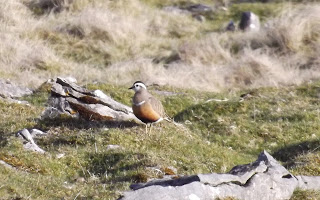
Dotterel record shots

(c) M. Bevan
 Record shots of the female Dotterel at Cwm Cadlan on 30th April. Phil Hill and Martin Bevan saw the pair at 19:05 following Alan Cripps' earlier find.
(c) M. Bevan

Wednesday, 8 May 2013

Sanderling G2YYWG

 Rob Jones and I found another couple of colour-ringed Sanderling on Jersey Marine beach yesterday. These 2 were far less cooperative in giving up their details and only one actually gave enough of a view  to observe the colour codes fully. G2YYWG has only ever been recorded at 3 locations and each recorded sighting has occurred in the month of May. It was caught in 2011 in western Iceland. The next year it turned up in North Uist on 15/5/12 and 11 days later it was observed on the beach where it was caught. Our record this year is the furthest south it has been seen.

Sanderling G4YWWW

 This Sanderling was found by Rob Jones on the 27/4/13 on Jersey Marine beach. It was first caught in May 2008 in western Iceland at a favoured staging point for the species. There are no summertime records on breeding grounds but this bird is likely to be a Greenland bird as Barry Stewart suggested in an earlier post. It has been recorded every May since 2008 in Iceland and will hopefully make it there again later this month. It has also been recorded in north-western France in every non-breeding season since May 2008. However, the dates on which it has been recorded in France suggest that it may go further south again? Indeed, observations of "the first sanderling ringed in Ghana have been reported in France today (28/4/13)" as we enter into the main migratory period for theses Arctic waders, reports Jeroen Reneerkens - Sanderling Project, International Wader Study Group.
The only records of this bird away from the observation hotspots are St Mary's Island, Whitley Bay, Northumberland on 9/4/13. This was 23 days after it was last reported in France and it turned up in Iceland 40 days after the St Mary's Island sighting. Prior to Rob's find this bird was last reported in France 26 days earlier.
G4YWWW
There are lots of unknowns still at play here, and the general movement will be of no great surprise to many. However, I find it fascinating to think of other birders watching these same birds, sometimes thousands of miles apart and over many years. The results are returned quickly too, with this project, so it's well worth the effort spending time to get the colour codes.

weighted distribution of Sanderling in Glamorgan

Monday, 6 May 2013

Sunday, 5 May 2013

Seawatching and Cuckoos

Seawatching from Port Talbot Docks 07:00 to 10:15
Common Scoter (24), Great Northern Diver (1), Whimbrel (20), Dunlin (41), Sandwich Tern (4) and "Commic" Tern (2). Also a small trickle of Hirundines heading west (c250) mainly Swallows, but a few Sand Martins and a House Martin also.

Some encouraging Cuckoo sightings from the last few days with a male at Pant-y-sais (3/5/13), 2+ male at Crymlyn Bog and a female at Pant-y-sais (4/5/13) and a female (above) at Port Talbot, today.
(MHi, RJ)

Thursday, 2 May 2013

National Bird News

BBRC News:
Olive-backed Pipit is to be dropped as a British rarity from 2013. It will now become a Welsh Records Panel [WRP] species. Lesser Scaup & Citrine Wagtail, the other species reviewed, will remain BBRC species. BBRC are also looking at species that have become noticeably more scarcer: Aquatic Warbler, Tawny Pipit, Coues's Arctic Redpoll & Rustic Bunting. The former two have occurred in Glamorgan.
A press release from BBRC concerning these species is due shortly.